
A cancer diagnosis comes with a long list of unfamiliar words, and “PARP inhibitor” is often one of the most confusing. Your oncologist mentions Olaparib, hands you a pamphlet full of biology terms, and sends you home to “look it up.” Most of what you find online is either oversimplified to the point of being useless, or written for researchers, not patients.
That gap leaves a lot of people staring at a prescription bottle without really understanding why this particular drug was chosen for them, or how it’s actually fighting their cancer.
This guide breaks down how Olaparib works, in plain language, from the molecular mechanism to what it means for your treatment plan. We’ll also cover who it’s typically prescribed for, common side effects, and the questions worth bringing to your next oncology appointment.
A quick but important note: this article is for education only. It is not medical advice and does not replace a conversation with your oncologist. Olaparib is a prescription medication used in cancer treatment, and decisions about whether it’s right for you depend on your specific diagnosis, genetic test results, and overall health.
What Is Olaparib?
Olaparib (sold under the brand name Lynparza) is an oral cancer medication that belongs to a drug class called PARP inhibitors. It was the first PARP inhibitor ever approved by the FDA, originally cleared in 2014 for advanced ovarian cancer.
Quick Overview of the Drug Class
PARP inhibitors are a form of targeted cancer therapy. Unlike traditional chemotherapy, which attacks all fast-dividing cells in the body, PARP inhibitors are designed to exploit a specific weakness found in certain cancer cells, particularly those with mutations in the BRCA1 or BRCA2 genes.
Olaparib is taken as a tablet, usually twice a day, and is most often used as a maintenance treatment after other cancer therapies have already reduced the tumor. It’s currently used in the management of certain ovarian, breast, pancreatic, and prostate cancers, depending on a patient’s genetic test results.
What Is a PARP Inhibitor?
To understand what Olaparib does, it helps to first understand what PARP actually is.
PARP stands for Poly (ADP-Ribose) Polymerase. It’s a family of enzymes that every cell in your body relies on, not something unique to cancer.
The Role of PARP Enzymes in Healthy Cells
Think of your DNA as a long strand that gets damaged constantly, just from normal cell activity, UV exposure, and everyday wear and tear. Most of this damage shows up as small, single-strand breaks, like tiny nicks in the strand.
PARP enzymes are part of your cell’s repair crew. Specifically, PARP1 and PARP2 detect these single-strand breaks and trigger a repair process called base excision repair (BER). This is one of two major DNA repair systems in your cells. The other, more robust system is called homologous recombination (HR), and it handles more serious damage, like double-strand breaks.
In a healthy cell, both systems work side by side as backups for each other. If one is impaired, the other can usually pick up the slack. This redundancy is exactly what Olaparib is designed to interrupt.
How Olaparib Works: The Science Explained Simply
In short: Olaparib blocks the PARP enzyme’s repair function, which causes DNA damage to build up inside cancer cells. In cancer cells that already have a faulty homologous recombination system (commonly due to BRCA1 or BRCA2 mutations), this leaves the cell with no working backup system, and it dies. This selective targeting of vulnerable cancer cells is called synthetic lethality.
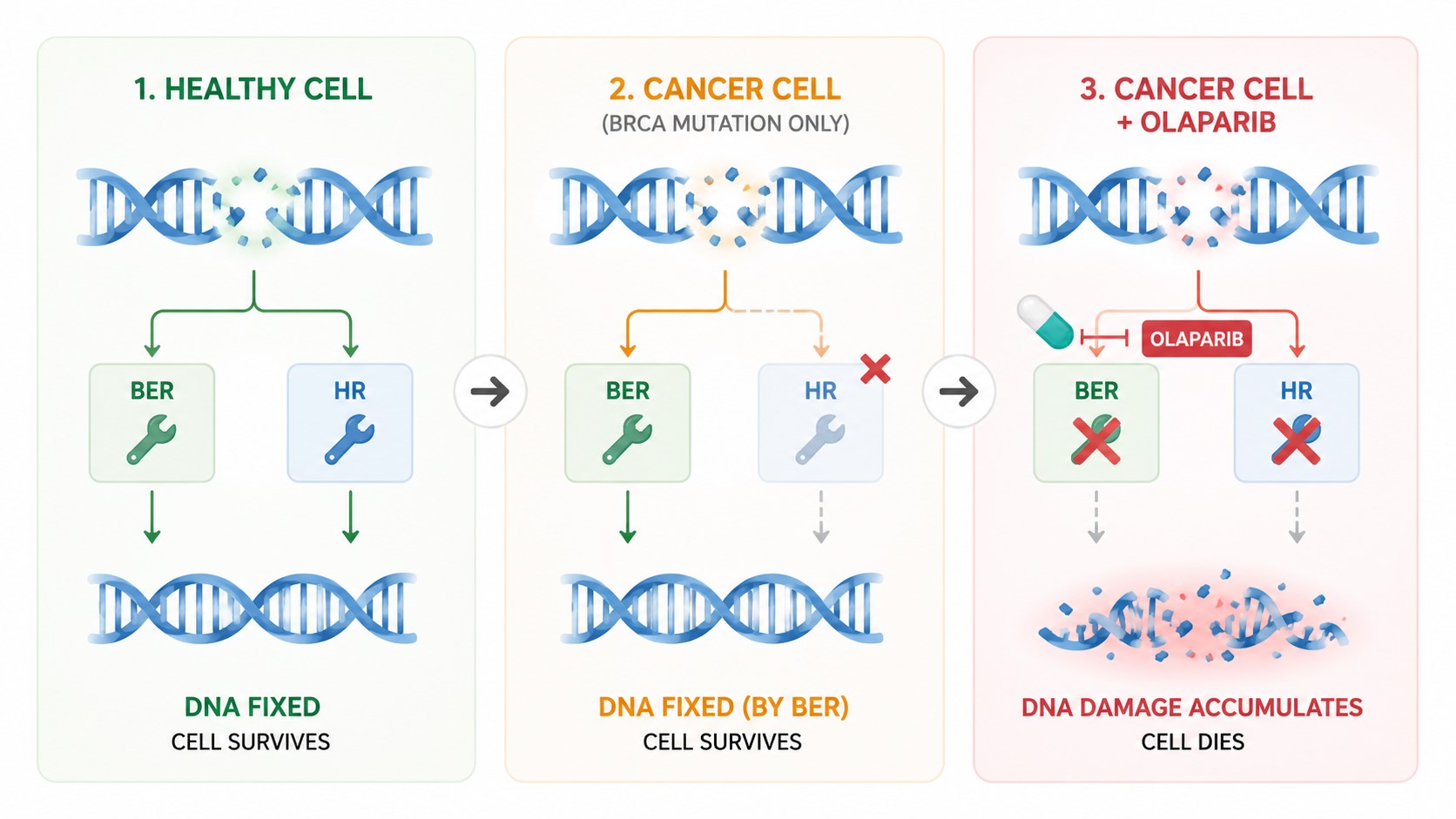
Here’s the step-by-step breakdown.
Step 1 – Blocking the PARP Enzyme
Olaparib binds tightly to PARP1, PARP2, and PARP3, preventing these enzymes from doing their normal repair job. It doesn’t just slow them down, either. Olaparib also “traps” PARP onto the damaged DNA strand, which physically blocks other repair machinery from accessing the site. This trapping effect is part of why Olaparib is more potent than simply removing the enzyme would be.
Step 2 – DNA Damage Builds Up Inside Cancer Cells
With base excision repair offline, single-strand breaks that would normally be patched up quickly are left unrepaired. As the cell continues to divide and copy its DNA, these unrepaired single-strand breaks get converted into far more dangerous double-strand breaks.
Step 3 – Synthetic Lethality and BRCA Mutations
This is the part where Olaparib becomes selective for cancer cells rather than indiscriminately toxic.
Double-strand breaks are normally repaired by the homologous recombination pathway. BRCA1 and BRCA2 are genes that play a central role in this homologous recombination repair process. When a cancer cell carries a mutation in BRCA1 or BRCA2, its homologous recombination system is already broken.
So picture it this way: a healthy cell has two backup repair systems. A BRCA-mutated cancer cell already has one of them down. When Olaparib disables the second system (base excision repair via PARP), the cancer cell is left with no way to fix its DNA damage at all. This dual failure of repair pathways leads to synthetic lethality, where the cancer cell’s DNA is forced through more error-prone, less reliable repair mechanisms that simply can’t keep up, and the cell dies.
This combination of two failures, each survivable on its own but lethal together, is the definition of synthetic lethality, and it’s the central concept behind how Olaparib and similar drugs work.
Why Healthy Cells Are Less Affected
Your normal, healthy cells generally still have a working homologous recombination pathway. So even when Olaparib blocks PARP-mediated repair in those cells, the backup system can still handle double-strand breaks well enough for the cell to survive. This is what makes PARP inhibitors more selective for cancer cells than traditional chemotherapy, although it doesn’t mean they’re free of side effects, which we’ll cover shortly.
Who Olaparib Is Typically Used For
Olaparib isn’t prescribed broadly. It’s used in cancers where genetic testing has identified specific DNA repair deficiencies.
BRCA1 and BRCA2 Mutations Explained
BRCA1 and BRCA2 are tumor suppressor genes. When they function normally, they help repair DNA and prevent cells from growing out of control. When they’re mutated, that protection breaks down, which is why BRCA mutations are linked to a higher risk of certain cancers, especially breast and ovarian cancer.
Importantly, BRCA mutations can be:
- Germline – inherited and present in every cell of the body, detectable through blood or saliva genetic testing
- Somatic – occurring only within the tumor itself, not inherited, and detectable only through tumor tissue testing
Knowing which type of mutation is present (and confirming it through an FDA-approved companion diagnostic test) is a required step before Olaparib is prescribed for most indications.
Cancer Types Where PARP Inhibitors Are Studied or Used
Based on current approved uses, Olaparib is most established in:
- Ovarian cancer – including maintenance treatment for BRCA-mutated and HRD-positive (homologous recombination deficient) advanced ovarian cancer
- Breast cancer – for HER2-negative, BRCA-mutated metastatic breast cancer
- Pancreatic cancer – as maintenance therapy in BRCA-mutated metastatic pancreatic cancer
- Prostate cancer – for BRCA-mutated metastatic castration-resistant prostate cancer, often combined with other hormone-targeting therapies
If your cancer type isn’t listed here, that doesn’t necessarily rule out Olaparib. Research into PARP inhibitors continues to expand into other tumor types with similar DNA repair deficiencies. Your oncologist will know the current approved and investigational uses relevant to your case.
Benefits of PARP Inhibition as a Treatment Approach

Compared to traditional chemotherapy, PARP inhibitors like Olaparib offer a few meaningful advantages for the right patients:
- Targeted mechanism – designed to exploit a specific vulnerability in cancer cells rather than attacking all dividing cells indiscriminately
- Oral administration – taken as a tablet at home rather than requiring infusion visits
- Maintenance use – can help extend the time before a cancer progresses after initial treatment with chemotherapy
- Established track record – the longest-studied PARP inhibitor, with over a decade of clinical data across multiple cancer types
That said, “targeted” doesn’t mean “side-effect free.” It means the drug’s main mechanism is more selective, not that the body won’t react to it.
Common Side Effects and Safety Considerations
What Patients Often Report
The most frequently reported side effects of Olaparib include:
- Nausea and vomiting
- Fatigue
- Anemia (low red blood cell count)
- Decreased appetite
- Diarrhea
- Headache
- Changes in taste (dysgeusia)
Because Olaparib can affect blood cell counts, your care team will likely monitor your blood work regularly throughout treatment.
When to Contact a Doctor
Some side effects, while less common, need prompt medical attention rather than a “wait and see” approach. These include signs of severe fatigue or unusual bruising/bleeding, persistent shortness of breath or new cough, signs of blood clots (leg swelling, pain, sudden chest pain), or unusual abdominal pain. If you notice any of these, contact your healthcare provider rather than waiting for your next scheduled appointment.
This is not a complete list of side effects or warnings. Always review the full prescribing information and safety profile with your oncologist or pharmacist before starting treatment.
Common Mistakes and Misunderstandings About Olaparib
“It’s basically chemotherapy.” Olaparib works through a completely different mechanism than traditional chemotherapy. It targets a specific DNA repair vulnerability rather than broadly attacking dividing cells.
“It will work the same for everyone.” Olaparib’s effectiveness depends heavily on a patient’s specific genetic profile, particularly BRCA status and homologous recombination deficiency. Two patients with the same cancer type can have very different responses based on their genetic test results.
“It replaces the need for other treatments.” Olaparib is frequently used as a maintenance therapy after chemotherapy or alongside other targeted agents, not necessarily as a standalone replacement for every other treatment.
“If genetic testing wasn’t mentioned, it doesn’t matter.” Confirmed BRCA or HRD status through an approved diagnostic test is typically required before Olaparib is prescribed for most indications. If this hasn’t come up in your treatment discussions, it’s worth asking about directly.
Questions to Ask Your Oncologist Before Starting Olaparib
Bringing a short list of questions to your appointment can help you walk away with real clarity instead of more confusion:
- Has my BRCA or HRD status been confirmed through testing, and what were the results?
- Why is Olaparib being recommended specifically for my case?
- What side effects are most likely for someone with my health history?
- How will my blood counts and overall health be monitored during treatment?
- Are there other treatments or combinations being considered alongside Olaparib?
- What symptoms should prompt me to call you immediately rather than wait?
Frequently Asked Questions (FAQs)
Is Olaparib a form of chemotherapy? No. Olaparib is a targeted therapy that works by inhibiting PARP enzymes involved in DNA repair. It works through a different mechanism than traditional chemotherapy drugs, which broadly attack rapidly dividing cells.
Does Olaparib only work for BRCA-mutated cancers? Olaparib is most established and effective in BRCA-mutated cancers and other cancers with homologous recombination deficiency. It has also shown benefit in some HRD-positive cancers without a confirmed BRCA mutation, depending on the cancer type and combination treatment used.
How long do patients typically take Olaparib? Treatment duration varies widely depending on cancer type, response, and tolerability. Some patients take it for a defined maintenance period; others may continue longer if their disease remains controlled and side effects are manageable. This is something your oncologist will determine based on your individual response.
Can Olaparib be combined with other cancer treatments? Yes, in some cases. Depending on the cancer type, Olaparib may be used alongside other targeted therapies. Combination use depends on your specific diagnosis and treatment plan.
Is Olaparib safe for everyone with a BRCA mutation? Not automatically. Eligibility depends on cancer type, prior treatments, overall health, kidney function, and other individual factors. A confirmed BRCA or HRD status is necessary but not the only consideration.
Conclusion
Olaparib represents one of the clearer examples of precision medicine in oncology: a drug designed to exploit a specific genetic vulnerability rather than attack cancer indiscriminately. Understanding the mechanism, blocking PARP-driven DNA repair to trigger synthetic lethality in cells that already have a homologous recombination defect, can make the difference between feeling like a passive recipient of treatment and feeling like an informed participant in your own care.
If you or a loved one has been prescribed Olaparib, the most important next step is a direct conversation with your oncologist about your specific genetic test results, treatment goals, and what to expect. For general medication information and guidance on locating your prescribed treatments, Medicine for World and mfw.com.bd/ are available as a resource alongside your care team, not a replacement for it.
Editorial note: This article should be reviewed by a licensed medical professional before publishing, given that it covers a prescription oncology medication. No dosing or treatment-decision guidance has been included; readers are consistently directed to consult their oncologist.